


Ever stared at a word and wondered if it looks wrong?
You’re not alone, and business is a classic culprit.
Plenty of people type bussiness and hit send without noticing.
Then a client, boss, or teacher spots it first.
That stings a bit.
Spelling slips like this happen to writers at every level.
The good news is they’re easy to fix.
So here’s the quick fix in the business vs bussiness debate.
Business is the correct spelling.
Bussiness is a common spelling mistake and nothing more.
This guide shows why people slip, how to spot the error, and how to remember the right form.
You’ll also get real examples, handy tricks, and answers to questions people ask most.
Short answer first, then the full story.
Ready? Let’s sort it out.
Quick Answer
The correct spelling is business.
Bussiness is a spelling error you should avoid.
Count the letters: B, U, S, I, N, E, S, S.
Only one S sits right after the U.
Business or Bussiness: Which Spelling Is Correct?
Business wins every time in standard English spelling.
Every major dictionary lists it, and none lists bussiness.
If you’re asking whether bussiness is a word, the answer is no.
It’s an incorrect spelling of a word you already know.
Both American English and British English agree here.
Unlike color and colour, there’s no regional split to worry about.
How to Spell Business? Is It Bussines or Bussiness?
Spell it B-U-S-I-N-E-S-S.
Say the letters slowly and you’ll lock it in.
Bussines adds an extra S early and loses one at the end.
Bussiness only adds the extra S early.
Both are wrong for the same reason.
That second S after the U doesn’t belong.
What’s the Difference Between Business and Bussiness?
Honestly, there’s no difference in meaning.
One is a real word and the other is a typo.
Picture a friend who sends resumes with bussiness in the summary.
The hiring manager won’t judge the idea, but they’ll notice the slip.
Which Is Correct, Busyness or Business?
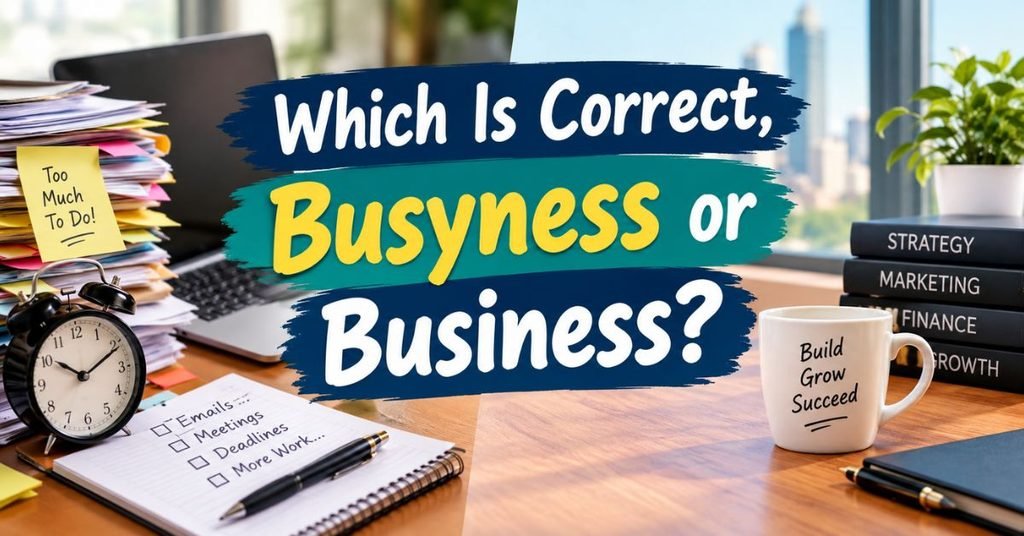
Both are real words, but they mean different things.
Busyness describes the state of being busy.
Business covers commerce, a company, or a matter of concern.
Pronunciation helps: BUSY-ness versus BIZ-ness.
You might say the busyness of the week wore you out.
Then you’d say the business opened a new branch.
Is It Spelt Buisness or Business?
Spelt is the British past tense of spell.
The answer stays the same either way: business.
Buisness swaps the I and the first S after it.
Fingers often move faster than eyes.
What’s the Difference Between Buisness and Business?
There’s no meaning gap here.
Buisness is just an incorrect word form.
The real question is why it happens.
Three reasons show up again and again.
Also Read : Noisy vs Noisey: Common Spelling Mistake Explained 2026
The Word Sounds Different From Its Spelling
You say BIZ-ness, and the U barely gets a voice.
That’s the heart of the problem.
The gap between sound and spelling trips up plenty of writers.
Your ear says one thing while the page says another.
English Spelling Is Not Always Predictable
English borrows from many languages.
Its spelling rules bend more than they hold.
Busy is said BIZ-ee, yet it’s spelled with a U.
Business follows that same odd pattern.
Repeated Letters Cause Typing Errors
The word packs three S’s and several similar letters.
Your fingers can double up or flip them without warning.
That’s a classic typing error.
A quick proofreading pass catches it fast.
Key Differences At A Glance
Here’s the whole story in one small table.
Screenshot it if you like.
| Spelling | Status | Note |
| business | Correct | Commerce, company, or concern |
| bussiness | Incorrect | Extra S after the U |
| bussines | Incorrect | Extra S early, missing final S |
| buisness | Incorrect | I and S swapped |
| busness | Incorrect | Missing I |
| busyness | Correct | State of being busy |
Only two rows are real words.
They just carry different meanings.
Also Read : Principal vs Principle: Common Mistakes & Examples 2026
What Does Business Mean?
Business is a standard noun.
It refers to commercial activity, like buying, selling, or offering services.
A company or organization also counts as a business.
So do work, trade, and professional matters you handle daily.
It can even mean personal concerns, as in that’s none of your business.
Context tells you which sense fits.
Why Bussiness Looks Wrong To Native Speakers
Fluent readers scan words as shapes, not letters.
An extra S changes that shape just enough to feel off.
Native speakers have seen business thousands of times.
So bussiness jumps out like a wrong note in a familiar song.
How To Remember The Correct Spelling
A few small tricks beat memorizing rules.
Try these three.
Each one links the word to something you already know.
Pick the one that fits your brain.
Think Of Busy
Business starts with busy.
If you can spell busy, you’ve got the first three letters.
Swap the Y for an I, then add NESS.
That’s how the word was built centuries ago.
Remember There Is Only One S After The U
Only one S sits right after the U.
Say it out loud: bus, then i, then ness.
Bussiness breaks that rule with two S’s up front.
Cover the extra S and the word looks right again.
Use Familiar Phrases
Phrases stick better than single words.
Think of mind your own business or strictly business.
Picture the phrase on a sign or a mug.
Your memory will keep the spelling along with it.
Common Mistakes People Make
Most errors fall into four patterns.
Knowing them helps you catch your own.
Check these against your drafts.
You’ll likely spot your personal habit fast.
bussiness
This one adds an extra S after the U.
It’s the most common misspelling of the bunch.
People double the S because the sound feels short and sharp.
Remove one S and you’re done.
buisness
Here the I and S trade places.
It’s a spelling mistake born from fast typing.
Slow down on the middle of the word.
Say bus, then i, then ness.
busness
This version drops the I entirely.
That matches how some people say the word aloud.
Break it into three parts: bus, i, ness.
The missing letter shows up right away.
bussines
This one stumbles on both ends.
It adds an S early and drops the last S.
Count the S’s: three in total.
One early, two at the finish.
Correct And Incorrect Examples
Seeing words in context makes the rule clearer.
Here’s a fast side by side.
Read each one aloud.
Your ear helps your eyes here.
Correct Examples
These sentences use the right spelling.
Steal them for your own writing.
- She runs a small business from home.
- Our business meeting starts at nine.
- Update your business website before the launch.
- He wrote a solid business plan for the bank.
Also Read : Steer vs Stear: Common Spelling Mistake Explained 2026
Incorrect Examples
These sentences carry a common typo.
Spot the problem before you read the fix.
- She runs a small bussiness from home.
- Our buisness meeting starts at nine.
- Update your busness website before the launch.
- He wrote a solid bussines plan for the bank.
Business In Professional Writing
Spelling shapes first impressions in professional writing.
Job applications, resumes, and client emails all get judged quickly.
The same goes for LinkedIn profiles, marketing materials, and college assignments.
In academic writing and formal usage, one typo can cost real credibility.
Here’s a tip for smooth professional communication.
Run spell-check software, then read the piece aloud.
Why One Typo Costs More Than You Think
Readers rarely say a typo bothered them.
They just quietly trust you a little less.
Imagine a business owner whose homepage says bussiness.
Visitors may wonder what else got missed.
Got a favorite typo story?
Share it in the comments and make someone else feel better.
Dictionary-Style Word Details
Here’s a quick reference card.
It covers meaning, use, and history.
Skim it or bookmark it.
Either way, it saves time.
Verb
Business is almost never used as a verb.
Old texts show rare uses, but modern writing skips them.
Use do business or run a business instead.
Those are the natural pairings.
Noun
Business works mainly as a noun.
It can be countable or uncountable.
You can say a small business or a lot of business.
Both are correct English.
Synonyms
Need another word?
These work in different situations.
- Company
- Organization
- Enterprise
- Commerce
- Trade
- Profession
- Occupation
Each one has a slightly different shade.
Company suits a firm, while occupation suits a job.
Example Sentences
Short examples show the range.
Here are three you can borrow.
- Business management is her favorite subject.
- The bakery is doing brisk business all weekend.
- That’s strictly business, nothing personal.
Notice how the spelling never changes.
Only the meaning shifts.
Word History
Business comes from the Old English word bisignes.
It joined an old word for busy with the suffix ness.
Back then it meant care or anxiety.
The sense of trade and commerce came later.
Phrases Containing
English loves business phrases.
These six show up constantly.
- Business as usual
- Monkey business
- Mind your own business
- Out of business
- Mean business
- Strictly business
Each one keeps the same spelling.
Use them as memory anchors.
Frequently Asked Questions
Which spelling is correct, business or bussiness?
In the business vs bussiness question, business is correct.
Bussiness is just a common typo.
How to spell business?
Spell it B U S I N E S S.
That letter order settles business vs bussiness for good.
Is bussiness a word?
No, bussiness isn’t a word.
In business vs bussiness, only business is real.
What is the difference between business and bussiness?
One is correct and one is a typo.
The business vs bussiness gap is spelling only.
Is bussiness correct English?
No, it isn’t correct English.
Business vs bussiness has one clear winner: business.
Why do people spell business as bussiness?
The sound and spelling don’t match well.
That’s why business vs bussiness confuses so many writers.
Is business or bussiness correct?
Business is correct.
Drop the extra S and business vs bussiness stops being a problem.
What does business mean?
It means commerce, a company, or a matter of concern.
Business vs bussiness never changes that meaning.
Which is correct, busyness or business?
Both are correct but mean different things.
Business vs bussiness is about spelling, while busyness means being busy.
Is it spelt buisness or business?
It’s spelt business.
Buisness is wrong, just like bussiness in the business vs bussiness debate.
What are the common misspellings of business?
Bussiness, buisness, busness, and bussines top the list.
All of them fall into the business vs bussiness trap.
Conclusion
The business vs bussiness question has a simple answer.
Business is correct, and bussiness is not.
Every time you face business vs bussiness, count the S’s.
One S follows the U, and two close the word.
That small check saves you from a common spelling mistake.
Simple rules beat guesswork.
It works in American English and British English alike.
Remember busy, and the rest falls into place.
You now know the business vs bussiness rule, the typos, and the tricks.
Use them in emails, resumes, and reports.
Run spell-check, then proofread out loud.
Business vs bussiness will never trip you up again.
Did this help?
Share it with a friend who types fast.
Drop your trickiest word in the comments, and let’s sort it out together.
Fresh questions keep this guide useful, so keep them coming.


3 thoughts on “Business vs Bussiness: Which Spelling Is Right in 2026?”