


Did you just type stear and wonder if it looks right?
You’re not the only one. Maybe autocorrect stayed quiet, or a friend swore it was fine. Here’s the short answer to Steer vs Stear: steer is the correct spelling in modern English.
Stear is not accepted in standard English. Let’s settle it once and for all.
Steer means to guide or control the direction of something.
You steer a car, a boat, or a conversation. It also names a young male cow raised for beef.
Stear only shows up in old texts, rare dialects, or typos. Stick with the ee spelling and you’ll be safe in school, business, and online publishing.
You’ll also get a simple memory trick that takes five seconds. No grammar degree needed.
Quick Answer
Use steer. It’s the only accepted spelling in dictionaries, style guides, and everyday writing.
Stear is a misspelling in modern writing.
Steer works as a verb and a noun. As a verb, it means to direct or guide.
As a noun, it means a castrated male cow raised for meat.
Has Anyone Heard of “Steer,” “Stere,” or “Stear”?
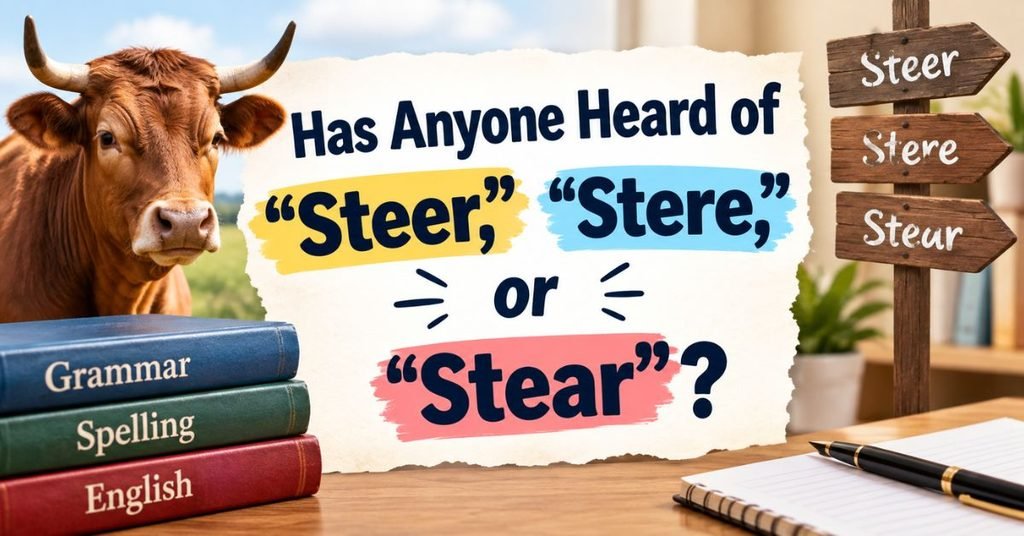
Most people know steer from driving lessons or a steakhouse menu.
Fewer people know stere, and almost nobody has met stear on purpose. Yet all three pop up in search bars every day.
Here’s why. They look and sound alike, so your brain treats them as one word.
That’s a classic trap among commonly confused words. The ear hears one sound, and the eye has to pick a spelling.
Only one of the three is a normal everyday word. Steer wins that contest by a mile.
Stere is a rare metric unit (more on that later). Stear is an uncommon word that modern writers should skip.
Steer vs. Stear: Which Is Correct?
Steer is correct. Stear isn’t.
If you’re asking is it steer or stear for an essay, an email, or a blog post, write steer every time.
Check any major dictionary and you’ll find an entry for steer.
You won’t find stear listed as a normal headword. That tells you which one is the correct modern spelling.
Think of it like a road sign. One sign points to the real town.
The other points to a dirt path that ended decades ago.
What Does “Steer” Mean?
Steer has two main jobs in English. It works as a verb and as a noun.
Both meanings are alive and well today.
Let’s break them down one at a time. Once you see them side by side, the steer meaning clicks fast.
As a Verb
As a verb, steer means to guide or control where something goes.
You can steer a car, steer a boat, or steer a bicycle. You can also steer things you can’t touch, like a conversation or a discussion.
Here are a few quick examples:
- She steered the car around the pothole.
- He steers the meeting back on topic every time.
- The captain steered the boat toward the harbor.
The past tense is steered, and the -ing form is steering. Both keep the ee.
As a Noun
As a noun, a steer is a castrated male cow. Farmers raise steers for beef production.
It’s a standard term in livestock talk and cattle auctions.
A steer is different from a bull. A bull isn’t castrated, and it’s kept for breeding.
An ox is usually a mature steer trained to pull loads. You’ll hear all three words on a ranch.
A second noun meaning exists too. In casual speech, a steer can be a tip or piece of advice.
Someone might say, thanks for the steer on that restaurant. If the advice was bad, you’d call it a bum steer.
| Also Read : |
| Humorous vs Humerous: Which One Should You Use? 2026 |
| Midday vs. Mid Day: Which Spelling Should You Use? 2026 |
| Crowler vs Growler: Which Keeps Beer Fresher? 2026 |
What Does “Stear” Mean?
Here’s the honest answer. In modern English, stear has no standard meaning.
Most dictionaries don’t list it, so the stear definition is basically empty.
When stear does show up, it’s usually one of three things:
- A typo for steer
- An old spelling found in historical texts
- A regional spelling or dialect spelling, or part of a name
English spelling wasn’t fixed until printing and dictionaries spread the rules.
Before that, writers spelled by ear, so one word could have many forms. Stear is a leftover from that messy era.
That’s why the stear word meaning is really just a spelling ghost.
It points back to steer, not to a separate idea.
Steer vs. Stear: The Main Difference
The main difference between steer and stear is simple. One is a real word today, and the other isn’t.
Steer is standard English. Stear is an obsolete spelling at best.
| Feature | Steer | Stear |
| Accepted in modern English | Yes | No |
| Part of speech | Verb and noun | None in standard use |
| Found in dictionaries | Yes | Rarely, if at all |
| Safe for school and business | Yes | No |
That’s the whole steer and stear difference.
No hidden rules and no tricky exceptions.
Why Do People Confuse Steer and Stear?
Sound is the biggest culprit. Steer and stear are read the same way out loud.
English spelling has plenty of ways to write the long ee sound, and that muddies things.
Think about ea words like beat, heat, and clear. Then think about ee words like beet, feet, and cheer.
Your brain sees both patterns daily. So it’s easy to swap them by mistake.
Old spellings add to the noise. Some people spot stear in an old book or a family name and assume it’s valid.
Add a distracted typing moment, and you get a spelling choice that looks fine until someone points it out.
Common Mistakes
Most errors come from typing fast or trusting a hunch.
Here’s what wrong and right look like side by side.
Incorrect
These are the incorrect spellings you’ll see most:
- He tried to stear the boat away from the rocks.
- Can you stear the conversation somewhere else?
- The farmer sold a stear at the market.
- She was stearing the car carefully.
Correct
Here are the fixes:
- He tried to steer the boat away from the rocks.
- Can you steer the conversation somewhere else?
- The farmer sold a steer at the market.
- She was steering the car carefully.
Notice the pattern. Every fix just swaps ea for ee.
That’s the one change that makes a stear misspelling disappear.
How to Remember the Correct Spelling
Try this: steer with ee has two e’s, like two eyes on the road.
When you steer, you keep your eyes on where you’re going. Two e’s, two eyes.
Here’s a second trick. Picture the wheel and steer pair. Both have double letters in their spelling.
It’s silly, but silly sticks. Say it once and you’ll remember it.
A third option is to link it to cheer and deer. Those are ee words too, and they rhyme with steer.
If it rhymes with deer, it’s spelled with ee.
Steer in Everyday English
Steer isn’t a fancy word. You use it more than you think.
Let’s look at three places it shows up most.
Driving
Driving is where most people first learn the word. The steering wheel is right there in front of you.
When you steer a car, you turn the wheel to change direction.
Say you’re driving on a wet road and the car starts to slide. Good advice is to steer gently into the slide, not against it.
That’s a real tip, and it uses the word exactly right.
Boating
On a boat, you steer with a helm or a tiller. The word has nautical roots, and it’s still standard today.
When someone asks you to steer a boat, they want you to hold the course.
Picture a small sailboat on a windy afternoon. The person at the tiller steers with tiny moves, not big ones.
Sailors will tell you that overcorrecting is the classic beginner mistake.
Leadership
Steer works well beyond vehicles. Managers steer a company through tough quarters.
Teachers steer a discussion toward the main point.
Imagine a team meeting that drifts off into small talk. A good leader says, let’s steer back to the deadline.
One sentence, and everyone knows what to do. That’s why the word is so handy in business writing.
Steer Idioms You’ll Hear
Steer pops up in a few idioms too. Knowing them helps you read and write more naturally.
Each one keeps the ee spelling.
- Steer clear of means to avoid something on purpose.
- A bum steer means bad advice or wrong information.
- Steer someone right means to give them good guidance.
You can say, I steer clear of spicy food before a flight.
Or, my friend gave me a bum steer about that hotel. These are casual phrases, but they show how flexible the word is.
Steer vs Stere: Don’t Mix Up the Third Word
Now for the odd one out. Stere is a real word, but it’s rare.
It’s a metric unit of volume equal to one cubic meter, mostly used for stacked firewood.
Unless you work with timber, you’ll probably never need it.
Still, it’s a good reminder that one letter can change a word completely. Steer and stere are not interchangeable.
Is Stear Ever Correct?
Almost never. In modern English usage, stear is not correct.
If a teacher, editor, or client sees it, they’ll mark it as a mistake.
There are small exceptions. It might be part of a surname or a place name.
It might also appear in a quote from an old document. In those cases, you copy it as written.
For everything else, treat stear as rarely used. When you’re unsure, pick steer.
It’s the safe choice for school writing, blog posts, and professional emails.
Steer vs. Stear Examples
Seeing both words in sentences makes the rule stick. Here are pairs you can scan quickly.
The wrong version comes first, then the fix.
- Wrong: She learned to stear a canoe. Right: She learned to steer a canoe.
- Wrong: Please stear us toward the exit. Right: Please steer us toward the exit.
- Wrong: The ranch sold three stears. Right: The ranch sold three steers.
- Wrong: He can stear a company through change. Right: He can steer a company through change.
Here are more steer sentence examples you can borrow:
- The pilot steered the plane around the storm.
- Try to steer the talk away from politics.
- Young steers graze on the far pasture.
If you’re wondering how to use steer in a sentence, start with a simple subject, the verb, then the thing being guided.
I steer the bike. Easy.
Steer vs. Stear in American and British English
Good news here. There’s no split between the two versions of English.
American English and British English both spell it steer.
| Point | American English | British English |
| Correct spelling | Steer | Steer |
| Stear accepted | No | No |
| Past tense | Steered | Steered |
So you don’t need to switch spellings when you write for a UK or US audience.
That makes life easier for English learners and writers who work across regions.
Quick Checklist Before You Publish
A short scan can save you from a red pen. Run through these steps before you hit send:
- Search your draft for stear and replace every match with steer.
- Check that each steering and steered keeps the ee.
- Use a spellchecker, but read once by eye too.
Tools like dictionaries and style guides help when you’re stuck.
A spellchecker can miss context, so your own eyes are the final filter.
Frequently Asked Questions
What’s the difference between steer and stear?
Steer is the correct word for guiding or controlling direction. In Steer vs Stear, stear is only an old or mistaken spelling.
Is stear a real word?
Not in standard English today. In Steer vs Stear, only steer appears in mainstream dictionaries and style guides.
Is it steer or stear?
It’s steer, always. Steer vs Stear has a clear winner, and that winner is the spelling with double e.
How do you use steer in a sentence?
Try this: She steered the car around the bend. Steer vs Stear is easy once you copy that pattern.
Is stear used in modern English?
No, it’s rarely used and counts as a misspelling. In Steer vs Stear, choose steer for every school or work document.
Final Thoughts
Steer vs Stear comes down to one clear rule. Write steer with double e.
Stear is an old spelling or a typo, and it doesn’t belong in modern writing.
Now you know the meanings, the examples, and a trick to remember. The next time Steer vs Stear pops into your head, you’ll answer in seconds.
Keep the two eyes on the road, and your spelling stays on track.
Did this clear up Steer vs Stear for you? Drop a comment with the spelling mistake you always trip over.
Share this with a friend who’s still typing stear.


2 thoughts on “Steer vs Stear: Common Spelling Mistake Explained 2026 ”