


Have you ever wondered whether to say half staff or half mast when a flag is lowered to honor someone? Both terms describe a flag flown below the top of its pole, often as a sign of mourning, respect, or remembrance.
The main difference comes from regional usage and context. Half staff is the standard term in American English, especially for flags displayed on land. Half mast is common in maritime settings and British English, although usage can vary. Knowing which phrase fits your situation helps you write clearly and follow proper flag etiquette. This guide explains both meanings, compares their differences, and provides examples you can use in everyday conversation and formal writing.
Quick Answer
Half staff and half mast both describe a flag lowered from its highest position to mark mourning, respect, or remembrance. In the United States, official communications generally use half-staff for flags on land.
Half mast is widely associated with ships and maritime traditions, and it is also common in British English. However, the terms aren’t separated by a universal rule that applies in every country or situation. Always follow the relevant flag protocol when discussing an official observance.
Meaning and Definition of Each Word
Understanding the words individually makes the half staff or half mast meaning easier to remember. Both expressions describe a flag’s position, but each has a different traditional association.
The distinction mainly concerns the structure supporting the flag and the language conventions followed in a particular place. Neither phrase describes a different kind of flag or a different level of mourning.
What Does Half Staff Mean?
The half staff meaning refers to flying a flag below the top of a flagpole. The flag is lowered to show respect after a death, during national mourning, or following another significant event.
In American English, half staff is the preferred term for flags displayed on land. You may see a flag at half staff outside government buildings, schools, public offices, and other locations following an official proclamation.
What Does Half Mast Mean?
The half mast meaning refers to a flag lowered from its normal position near the top of a mast or pole. The expression has a strong connection with ships, where a mast supports sails, flags, and other equipment.
The term also appears in British English and other English-speaking regions. A flag at half mast can mark a death, a tragic event, or a period of national remembrance, depending on local customs and official instructions.
Key Differences Between Half Staff and Half Mast
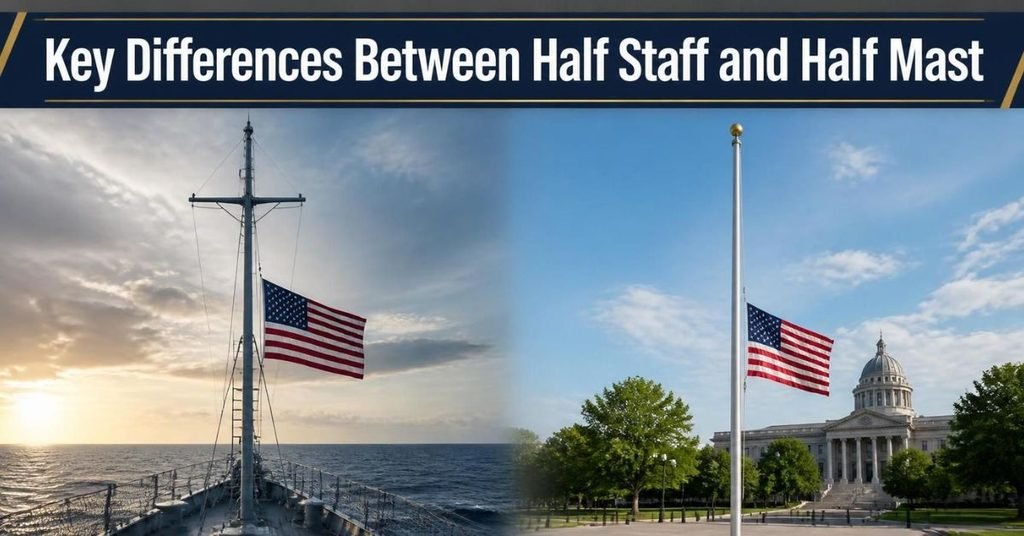
The main half staff vs half mast distinction involves traditional usage rather than the flag’s purpose. Both phrases can communicate mourning, honor, and remembrance, but the preferred term depends on location and context.
In the United States, official guidance generally uses half-staff for flags on land. Maritime traditions and British English commonly use half-mast, although individual countries may follow their own rules.
The expressions aren’t always interchangeable in official communication. If you’re writing about a government building in the United States, use half-staff unless the relevant authority specifies otherwise. For a ship or a British context, half-mast may be more appropriate.
Comparison Table
This table summarizes the half staff or half mast difference and shows when each expression is commonly used.
| Feature | Half staff | Half mast |
| Main association | Flags on land in the United States | Ships and maritime settings |
| American English | Preferred for land-based flags | Used in maritime contexts |
| British English | Less common in traditional usage | Commonly used |
| Physical meaning | Flag lowered below the top of its pole | Flag lowered below the top of its mast or pole |
| Common purpose | Mourning, respect, remembrance | Mourning, respect, remembrance |
| Official usage | Follow applicable U.S. protocols | Follow the relevant national or maritime protocol |
Examples in Sentences
Examples make the correct usage of half staff and half mast easier to recognize. Pay attention to the setting and the language convention in each sentence.
Both expressions describe a lowered flag, so the surrounding details usually tell you which term fits best. In formal writing, consistency matters as much as word choice.
Using Half Staff
Use half staff when writing about flags displayed on land in the United States. These examples reflect common American usage.
- The governor ordered the state flag flown at half staff after the tragedy.
- The school lowered its flag to half staff to honor the former principal.
- Flags at government buildings remained at half staff during the mourning period.
- The national flag flew at half staff in remembrance of the victims.
In these sentences, the setting is land-based and the wording follows American English convention. For an official observance, check the applicable proclamation for dates and requirements.
Using Half Mast
Use half mast when the context involves maritime traditions or English usage that favors the expression. These examples illustrate common usage rather than a universal protocol.
- The ship flew its flag at half mast to honor a deceased crew member.
- The vessel lowered its flag to half mast during the memorial service.
- In Britain, the flag was flown at half mast following the announcement.
- The naval fleet observed the mourning period by lowering its flags.
The wording fits maritime and British contexts. However, a specific navy or government may publish its own instructions, so check the relevant guidance when precision matters.
| Also Read |
| Forrest vs. Forest: Meaning and Differences Explained 2026 |
| Isle or Aisle: Meaning, Usage, and Examples 2026 |
| Bear Weight or Bare Weight: Meaning and Usage 2026 |
Common Mistakes
The most common common usage mistakes happen when writers assume both expressions have identical regional rules. Although the basic meaning is similar, the preferred wording changes with the country and setting.
Another mistake is treating half staff as a strict measurement of exactly 50 percent of a pole’s height. Flag protocols usually describe a customary position below the top, and the exact placement can depend on the applicable rules.
Incorrect Usage:
These examples show wording that may sound unnatural in a particular context. The problem is usually regional convention, not a completely different meaning.
- The U.S. government building displayed its flag at half-mast, despite using standard American land-based terminology elsewhere.
- The ship lowered its flag to half staff in a passage that consistently follows traditional maritime terminology.
- Every country must use half-staff because it is the only grammatically correct expression.
The first two sentences may be inconsistent with the expected convention in their stated contexts. The third makes a false universal claim because English usage varies by region.
Correct Usage:
Choose the expression that matches the location and the style you’re following. For official American land-based flags, half staff is generally the appropriate term.
- The governor ordered the state flag flown at half staff.
- The crew lowered the ship’s flag to half mast.
- British officials announced that the Union Flag would fly at half mast.
The examples follow common conventions, but official instructions should always guide actual flag displays. A country’s government or maritime authority may specify particular wording and procedures.
Mistake 1: Using Them Interchangeably Everywhere
The expressions have similar meanings, but that doesn’t mean every context treats them as identical. Using one term throughout an article without considering its audience can make the writing feel inconsistent.
For example, an article about U.S. state government buildings should generally use half staff. An article about British flag etiquette may be better served by half mast, provided it follows the relevant guidance.
Mistake 2: Ignoring Context
The correct expression depends on more than whether a flag is physically lowered. Regional English, official protocol, and the setting all help determine the appropriate wording.
Before publishing, ask yourself three questions:
- Is the article about the United States, Britain, or another country?
- Is the flag displayed on land or aboard a vessel?
- Does an official authority specify the terminology?
These checks help you choose wording that fits the subject. They also reduce errors in formal writing and official communication.
Tips to Remember the Difference
A simple memory aid can help you remember the usual distinction. Think of staff as the pole commonly found outside a building and mast as the structure associated with a ship.
This isn’t a strict grammatical rule, but it works as a quick reminder. If you remember the setting, you’ll usually find the right term without hesitation.
Here are three practical tips:
- Staff: Think of flags outside schools, courthouses, and government offices in the United States.
- Mast: Think of ships, naval traditions, and maritime settings.
- Check the region: Remember that British English commonly uses half-mast, including for flags displayed on land.
If you’re unsure, check an official flag protocol or a trusted style guide. That extra step matters when you’re writing about a national observance or a public memorial.
When to Use Each Word
Choosing between the two expressions becomes easier when you consider your audience first. The correct usage of half staff and half mast depends on regional convention and the type of flag display you’re describing.
For everyday conversation, either expression may be understood in many English-speaking settings. For official communication, however, using the expected local term shows care and consistency.
Use Half Staff When:
Use half staff when writing in American English about a flag displayed on land. This is the conventional wording for many U.S. government announcements and public observances.
Typical examples include flags at state capitols, public schools, courthouses, and municipal buildings. If a governor or the president issues a flag-lowering order, follow the wording used in the official announcement.
Use Half Mast When:
Use half mast when discussing maritime flag displays or writing for an audience that follows British English conventions. The term appears frequently in guidance about the Union Flag and other official flags in the United Kingdom.
For example, a report about a ship honoring a deceased crew member might use half mast. The same expression is also appropriate in British reporting about official mourning, according to the relevant context and guidance.
Grammar Rules (If Applicable)
Both half staff and half mast work as noun phrases. The word half describes the position, while staff or mast identifies the structure associated with the flag.
You can use either phrase after verbs such as fly, lower, and keep. For example, a sentence might say that officials lowered the flag to half staff or that a vessel kept its flag at half mast.
Hyphenation depends on how the expression appears in a sentence and the style guide you’re following. In American official writing, half-staff is common, especially in compound expressions such as flown at half-staff. British official guidance often uses half-mast or half-masted. Consistency matters more than applying one spelling convention to every country.
Synonyms or Related Words
There isn’t a perfect synonym that replaces half staff or half mast in every sentence. However, related expressions can help you explain the action without repeating the same phrase.
Useful alternatives include:
- Flag lowered in mourning: Describes the purpose of the display.
- Flag at half height: A general description of the flag’s position.
- Lowering a flag: Names the action rather than the final position.
- Sign of mourning: Explains the symbolic meaning.
- Flag etiquette: Refers to accepted practices for displaying flags.
- National mourning: Describes an officially recognized period of grief.
These phrases are useful in explanatory writing, but they aren’t always interchangeable with the established terms. In particular, flag at half height is a general description rather than a substitute for a country’s official terminology.
Why Are Flags Lowered to Half Staff or Half Mast?
A lowered flag is a visible way to express public grief, respect, and remembrance. Governments and organizations may use this gesture after the death of a public official, a military member, or another person whose passing has national or local significance.
Flags may also be lowered following a major tragedy or during a designated memorial observance. In the United States, official guidance identifies deaths, national tragedies, and remembrance occasions among the reasons for flying the flag at half-staff.
The meaning depends on the event and the authority issuing the instruction. A lowered flag doesn’t automatically mean the same mourning period applies everywhere, so check the official announcement for the reason and duration.
What Are the Rules for Lowering Flags?
Rules for lowering flags vary by country, institution, and occasion. In the United States, the president and state governors can issue orders for flags to fly at half-staff, while other rules may apply to particular locations or observances.
In the United Kingdom, official instructions can specify which flags should be lowered and how long the arrangement should remain in place. Guidance for the Union Flag also explains that half-masting involves raising the flag to the top before lowering it to the designated position.
Don’t assume that every school, business, or private flagpole must follow an identical schedule. Check the applicable authority’s current instructions before changing a flag for an official occasion.
Half Staff or Half Mast in American and British English
The difference between American English usage and British English usage is one of the clearest ways to choose the correct expression. American English generally favors half staff for land-based flags, while British English commonly uses half mast.
This difference doesn’t mean one expression is grammatically correct and the other is wrong. Both are established English terms, and regional convention helps determine which sounds natural in a particular setting.
For example, an American news report might describe a state flag flying at half-staff after a governor’s announcement. A British report might describe the Union Flag flying at half-mast following an official mourning instruction.
Frequently Asked Questions (FAQs)
1. Is it half staff or half mast?
Both are correct. Half staff is standard in American land-based usage, while half mast is common in maritime contexts and British English.
2. Which term is more common?
It depends on the region and context. American English generally favors half staff for land-based flags, while British English commonly uses half mast.
3. Can I use half mast on land?
Yes. Half mast is commonly used for land-based flags in Britain and other regions. Follow your country’s official flag protocol.
4. Why are flags lowered?
Flags are lowered to show mourning, respect, or remembrance. Governments may order this after deaths, national tragedies, or significant memorial events.
5. What does half mast mean historically?
Half mast is associated with maritime traditions and mourning at sea. Over time, the expression also became common for flags displayed on land.
6. Is there a difference in British and American English?
Yes. American English generally prefers half staff for flags on land, while British English commonly uses half mast in similar situations.
Conclusion
The choice between half staff or half mast mainly depends on regional usage and context. Both expressions describe a flag lowered below its highest position to show mourning, respect, or remembrance.
In American English, half staff is the usual term for flags displayed on land. Half mast is common aboard ships and in British English, including for flags outside public buildings.
When writing about official flag etiquette, check the relevant country’s rules rather than relying on a general language convention. Pay attention to the location, audience, and wording used by the authority responsible for the flag.
Understanding the half staff or half mast difference helps you write more accurately and avoid common usage mistakes. Choose the term that fits your subject, keep your wording consistent, and verify official instructions when the occasion calls for precision.


1 thought on “Half Staff or Half Mast: Key Differences in 2026”