


You type a word, pause, and wonder if it needs that extra e.
It happens to everyone who writes about food, fire, or weather.
The Smoky vs. Smokey question trips up even careful writers.
Maybe you’re labeling a jar of paprika or writing a menu.
Here’s the quick answer you came for.
Smoky is the correct spelling for the adjective.
Use it for flavor, air, rooms, and anything touched by smoke.
Smokey isn’t a typo everywhere, though.
It shows up in names, like Smokey Bear and Smokey Robinson.
Some dictionaries also list it as a rare variant.
So where’s the line between the two?
You’ll see that clearly in the next few minutes.
We’ll cover meaning, examples, history, and easy fixes.
Let’s start with the fast version.
Quick Answer: Smoky Or Smokey?
Smoky is the standard adjective.
Use smoky when you describe smoke flavor, smoky air, or a smoke-filled room.
Smokey belongs to names and nicknames.
Think Smokey Bear, Smokey Robinson, or a gray cat called Smokey.
Is It “Smoky” or “Smokey”?
Most of the time, it’s smoky.
If you’re describing something, skip the extra e.
People get stuck because both words look right.
Say them out loud and they sound identical, which makes the choice harder.
What Is Correct, “Smoky” or “Smokey”?
The correct spelling for the adjective is smoky.
You’ll find it in standard English and in American English writing.
Smokey works as a proper name or a variant spelling.
Some dictionaries list it as less common, and most editors still change it in descriptions.
Smokey or Smoky: What’s the Difference?
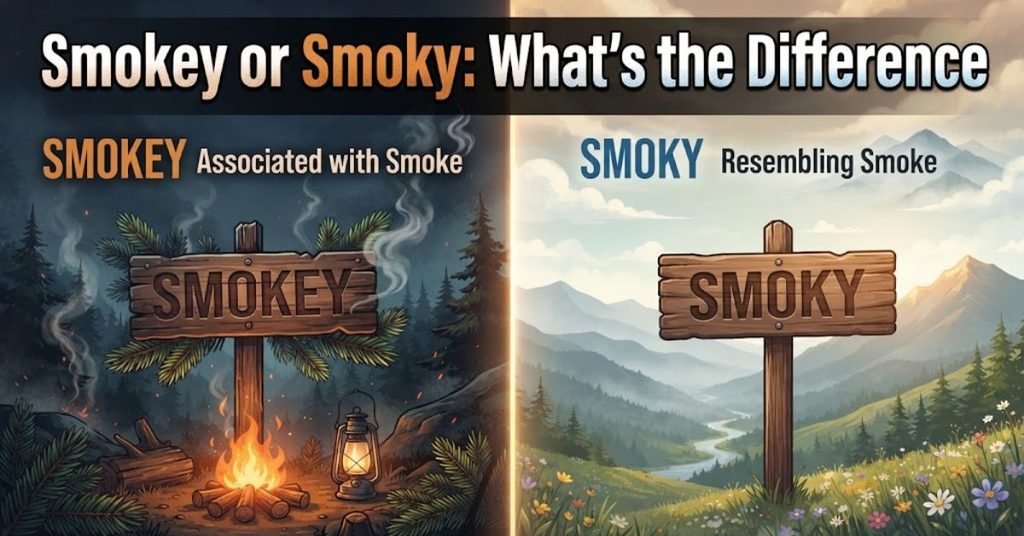
The spelling difference is just one letter.
The usage difference is much bigger.
Smoky describes things.
Smokey labels people, characters, and brands.
That split keeps your writing clean.
It also keeps it consistent from page to page.
Why Is It Spelled Smoky and Not Smokey?
English often drops a silent e before a y ending.
Smoke becomes smoky, just like shake becomes shaky and ice becomes icy.
That’s one of the English spelling rules that works most of the time.
It keeps words short and easy to read.
Is It Smokey or Smoky Taste?
It’s smoky taste, with no e.
The same goes for smoky flavor, smoky aroma, and smoky smell.
Picture a bowl of chili with chipotle and charred peppers.
You’d call that smoky, and so would any menu.
Writing a recipe card?
Stick with smoky every single time.
Is There an E in Smoky?
No, there isn’t.
S, M, O, K, Y spells the whole word.
The e from smoke disappears when the y joins the end.
Only the noun and the verb keep it.
Why Does Smoky Not Have an E?
A silent e usually drops before an ending that starts like a vowel.
The letter y does that job here, so the e steps aside.
It’s the same logic behind bony, shiny, and rosy.
Once you notice the pattern, smoky spelling feels natural.
Why Is Smoky Not Spelled Smokey?
Smokey breaks the usual pattern.
It keeps the e and adds a y, which most adjectives don’t do.
Still, famous names pushed that form into view.
Seeing it often made the longer spelling feel familiar.
| You May Also Like: |
| Chief vs Cheif: Correct Spelling and Meaning Revealed 2026 |
| Steer vs Stear: Common Spelling Mistake Explained 2026 |
| Business vs Bussiness: Which Spelling Is Right in 2026? |
Why People Confuse Smoky And Smokey
Pop culture does most of the damage.
You see Smokey Bear on signs and Smokey Robinson on playlists.
Your brain stores that look and applies it to everyday writing.
Autocorrect often stays quiet too, since it treats smokey as a name.
The two words are also pronounced the same.
With no sound clue, spelling feels like a coin toss.
What Does Smoky Mean?
Smoky means full of smoke or containing smoke.
It also covers smelling like smoke or tasting like it.
A fireplace can make a room smoky.
A slow burned brisket can have a smoky bite.
It can describe a smoke-like quality too, such as a gray, hazy color.
That’s why smoky eyes is a makeup look, not a fire hazard.
What Does Smokey Mean?
Smokey usually isn’t a description at all.
It’s a name or nickname, and sometimes a variant spelling.
Smokey Bear is the best known example.
He’s the wildfire prevention mascot of the U.S. Forest Service.
Old CB radio slang also used Smokey for highway patrol officers.
That’s another case where the name carries the e.
Meaning And Usage Difference
Meaning and usage split cleanly once you see them side by side.
Here’s a quick snapshot.
| Word | Role | Best used for |
| smoky | standard adjective | flavor, air, rooms, colors |
| Smokey | proper name or nickname | people, mascots, brands |
Compare smoky bacon with Smokey Bear.
One describes a food, and the other names a character.
Tone, Context, And Formality
Professional writing needs standard writing, so use smoky.
Reports, menus, and product pages should follow that rule.
Informal contexts give a little more room, but only for names.
A text to a friend called Smokey is perfectly fine.
Creative writing can bend rules for a character.
Even then, pick one spelling and keep it consistent.
Smoky vs Smokey in American English
American English treats smoky as the normal adjective.
Most newspapers, cookbooks, and style guides follow that habit.
Smokey still appears in names and titles.
That’s why you’ll see both spellings in one article, and both can be right.
Which One Should You Use?
Use smoky for every description.
Use Smokey only when it’s someone’s real name.
Here’s a quick test.
If you can swap in smoke-filled, go with smoky.
Easy Memory Trick
Think of smoke losing its e when the y shows up.
The e leaves, the y arrives, and you get smoky.
For names, picture a bear in a ranger hat.
Smokey Bear keeps his e, and so does every name.
When One Choice Sounds Wrong
Smokey looks wrong in a recipe.
Smoky looks wrong next to Smokey Bear.
Names are the exception to every spelling rule.
Always copy a name exactly the way the person writes it.
The Smoky Mountains show how this works in real life.
The national park uses the y only form in its official name.
Common Mistakes And Quick Fixes
Three slips cause most errors.
Here’s how to spot and fix each one.
Mistake 1: Adding Extra “E”
Writers add an e because smoke has one.
That habit is hard to shake.
The fix is simple.
Cross out the e, then add a y.
Mistake 2: Using A Name Spelling As A Description
Smokey Bear is famous, so people copy his spelling.
Then they write smokey flavor on a label.
Ask yourself one question.
Am I naming something or describing it?
Naming gets Smokey.
Describing gets smoky.
Mistake 3: Assuming Both Forms Are Equal
Some dictionaries list smokey as a variant.
That doesn’t make it equal in daily use.
Most editors prefer smoky.
Choose the accepted spelling and move on.
Everyday Examples
Examples make the rule stick.
Here are real situations sorted by topic.
Food Examples
Smoky paprika gives paella its deep color.
A smoky barbecue sauce pairs well with ribs.
Coffee fans notice a smoky taste in dark roasts.
Whisky lovers chase a smoky finish.
Environment Examples
After a campfire, your jacket carries a smoky smell.
Wildfire season turns the smoky sky orange.
A smoke-filled room feels heavy and stuffy.
Old jazz clubs had a smoky atmosphere most nights.
Name Examples
Smokey Bear still reminds us to prevent wildfires.
Smokey Robinson wrote hit songs for Motown.
Your neighbor’s gray cat might be Smokey.
Names follow the owner’s spelling, always.
Dictionary-Style Word Details
Here’s the dictionary-style word details view.
It covers grammar, synonyms, examples, and history.
Verb
Neither smoky nor smokey works as a verb.
The verb is smoke, as in smoke a salmon.
Related forms include smoked and smokes.
Those keep the e.
Noun
Smoky isn’t a standard noun.
Still, people say the Smokies when they mean the mountain range.
Smokey works as a noun in slang and names.
In old CB talk, it meant a highway patrol officer.
Synonyms
Synonyms depend on the sense you want.
Here’s a quick list for each word.
Smoky
Good swaps include hazy, misty, smoke-filled, and charred.
Pick based on whether you mean air, color, or flavor.
Smokey
Smokey has no true synonyms.
You can’t swap a name for another word.
Example Sentences
Short examples show how each form behaves.
Notice how the role changes the spelling.
Smoky
The chili had a smoky flavor I couldn’t forget.
Wildfire haze left the smoky air thick over the highway.
Smokey
Smokey Robinson sang the closing song of the night.
We adopted a gray kitten and named her Smokey.
Word History
Smoke comes from the Old English word smoca.
Adding a y created smoky, which describes anything touched by smoke.
Smokey Bear arrived in 1944 as a wildfire prevention character.
The name stuck, and so did its spelling.
A 1952 song added the word the, so some people say Smokey the Bear.
His official name is simply Smokey Bear.
Phrases Containing
Phrases show how often each spelling appears.
Here’s a quick sample of each.
Smoky
Common ones include smoky eyes, smoky quartz, smoky bacon, and smoky barbecue.
Smoky mountains and smoky room also pop up daily.
Smokey
Popular ones include Smokey Bear, Smokey Robinson, and Smokey and the Bandit.
Each one is a proper name, so the spelling stays.
Frequently Asked Questions
Is it smoky or smokey?
In the Smoky vs. Smokey debate, smoky wins for descriptions.
Use Smokey only for names.
Is Smokey ever correct?
Yes, in Smoky vs. Smokey, Smokey is right for names like Smokey Bear.
Some dictionaries also list it as a rare variant.
Is smoky flavor spelled with an e?
No. In Smoky vs. Smokey, smoky flavor never takes an e.
Write smoky flavor, smoky taste, and smoky aroma.
What does smoky mean?
Smoky means full of smoke, smelling like smoke, or tasting like smoke.
That’s the core of Smoky vs. Smokey.
Conclusion
Smoky vs. Smokey comes down to one simple rule.
Use smoky to describe flavor, air, and atmosphere.
Use Smokey only for names and nicknames.
That’s the whole Smoky vs. Smokey story.
Remember the pattern: smoke loses its e when y arrives.
Now the Smoky vs. Smokey choice shouldn’t slow you down.
Still unsure about a tricky sentence?
Drop it in the comments, and I’ll help you sort it out.
Know a friend who mixes these up?
Share this guide with them.
Keep one thing in mind: consistency matters as much as correctness.
Pick the right spelling once, then stick with it.
Your readers will notice, even if they never say so.
With Smoky vs. Smokey settled, you can write with confidence.


1 thought on “Smoky vs. Smokey: Which Is Correct?”